

From Chaos to Clarity: How to Structure Your Service Packages
Many service businesses grow by saying yes to everything. Every client gets a slightly different scope, a custom quote and a new set of promises. It feels flexible at first, then it becomes chaos: inconsistent pricing, unclear deliverables and work that is hard to repeat. This guide shows how to structure service packages so clients understand your value and you can deliver it consistently.
Learning how to structure service packages turns that chaos into clarity for you and for your clients.
Signs your offers need restructuring
- You write a custom proposal for almost every inquiry.
- Clients regularly ask what exactly is included.
- Two clients paying the same price receive very different amounts of work.
- You dread quoting because you are never sure what to charge.
A simple four-step framework
- List what you actually deliver. Write down every task and outcome from your last ten projects.
- Group by outcome, not effort. Bundle tasks into the results clients care about, such as getting found online or saving time each week.
- Create three tiers. An entry option, a core option and a premium option, each with a clear scope and a clear result.
- Define boundaries. State what is included, what is not, and how extra requests are handled.
An illustrative example
Picture a solo marketing consultant who quotes every project from scratch. After mapping past work, they notice three patterns: clients who need a strategy session, clients who need a monthly content plan and clients who want everything handled. Those patterns become three named packages with fixed deliverables. Quoting time drops, and prospects can choose with confidence.
Why packaging helps growth
- Clients understand what they are buying, so decisions come faster.
- Delivery becomes repeatable, which makes systems and automation possible.
- Pricing reflects value instead of hours.
Start with the outcome
When owners ask how to structure service packages, the first answer is almost always the same: start with the result the client wants, not with your list of tasks. A client does not want “ten hours of bookkeeping.” They want accurate books, peace of mind at tax time and clear monthly numbers. Name that outcome at the top of each package, then list what you do to deliver it.
Outcome-based service packages are easier for clients to compare, easier for you to explain and easier to price based on value rather than time.
Build clear tiers
Three tiers work well for most small businesses because they give clients a choice without overwhelming them.
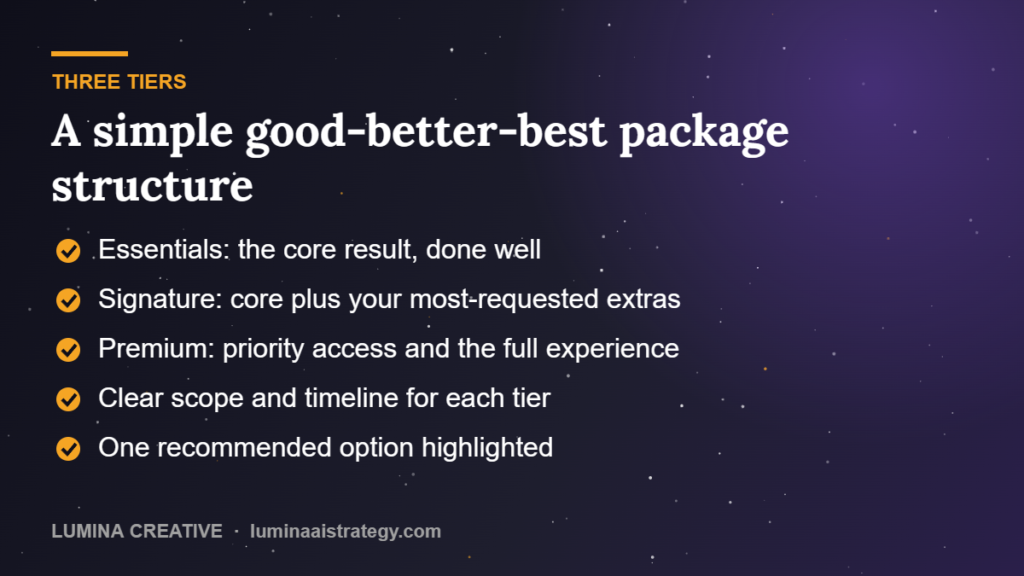
- Essentials: the core result, delivered well, with a clear scope.
- Signature: the core plus the extras most clients already ask for. This is usually the tier you recommend.
- Premium: faster turnaround, more access or a done-for-you experience for clients who value speed and convenience.
Make the differences between tiers obvious. If a client cannot tell why one package costs more than another, the structure needs to be simpler.
Price service packages with confidence
Pricing is where many owners hesitate. A few principles help:
- Know your costs and margins. Each package should be profitable even when delivered exactly as promised.
- Anchor to value. Consider what the result is worth to the client, not only what the work costs you.
- Avoid unlimited promises. “Unlimited support” invites scope creep. Define limits clearly.
- Round to clean numbers. Simple prices feel more confident and are easier to remember.
- Review prices yearly. Costs rise, and your expertise grows. Your prices should keep up.
Define the scope in writing
Every package needs a short scope: what is included, what is not, the timeline and how changes are handled. A clear scope protects the client relationship as much as it protects your time. When a request falls outside the package, you can point to the scope and offer an add-on, rather than quietly absorbing extra work.
Present your packages so clients can choose
Show your service packages side by side, with the outcome, the main inclusions and the price for each. Highlight the recommended option. Use plain language, avoid jargon and keep each list short. Add one or two testimonials nearby so new clients can see what working with you is like.
Launch your new packages
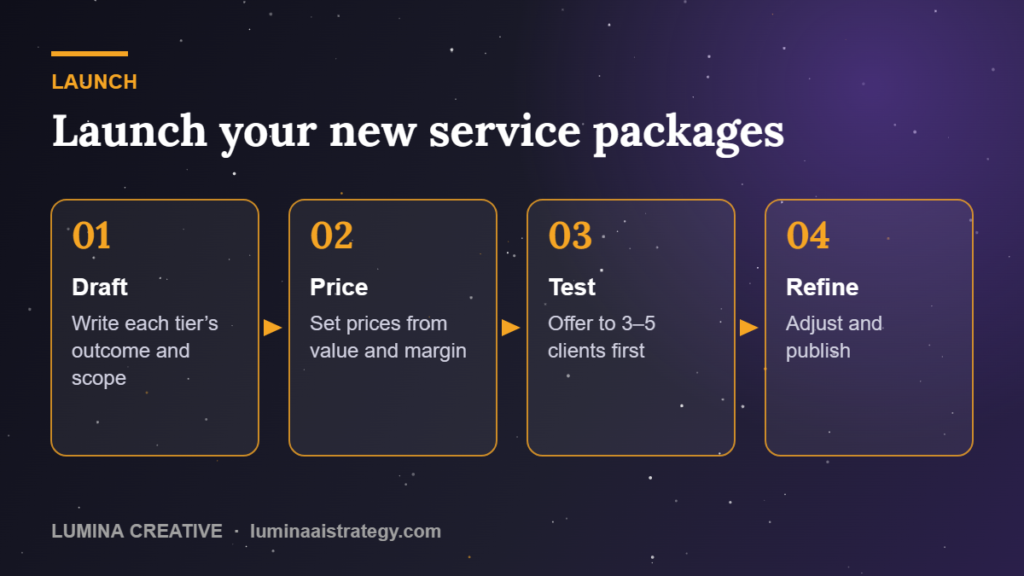
- Draft the outcome, scope and timeline for each tier.
- Price each tier using your margins and the value of the result.
- Test the packages with three to five current or new clients and listen to their questions.
- Refine the wording and scope, then publish them on your website and in proposals.
The U.S. Small Business Administration’s guide to pricing and marketing offers more background if you are setting prices for the first time.
Common mistakes when you structure service packages
- Too many options. Five or six packages create decision fatigue. Three is usually enough.
- Tiers that are too similar. If the only difference is a slightly higher number of hours, clients will choose the cheapest option.
- Listing tasks instead of results. Clients care about what changes for them, not the internal steps you take.
- Hiding the price. For many small service businesses, showing at least a starting price filters out poor-fit inquiries and builds trust.
- Never revisiting the structure. Packages should evolve as you learn what clients value most.
Add-ons and one-off services
Not every request fits neatly into a tier. Create a short list of add-ons for common extras, such as rush delivery, an extra revision round or an additional location. Price each add-on clearly. This lets clients customize without turning every proposal into a custom quote, and it gives you a simple way to say yes to extra work without giving it away for free.
Retainers and recurring packages
If clients need your help every month, consider a recurring package with a defined monthly scope. Recurring service packages create more predictable revenue for you and more consistent results for clients. Be specific about what is included each month, how unused time is handled and how either side can change or end the arrangement.
How packages make your business easier to run
Well-structured service packages do more than help clients choose. They make delivery easier, because every client in the same tier receives the same core process. They make hiring easier, because you can train someone on a defined scope. And they make your numbers easier to forecast, because you know what each package earns and costs. Packaging is one of the simplest ways to turn a busy practice into a business that can grow.
An illustrative example
Imagine a marketing consultant who used to write a custom proposal for every inquiry. After restructuring, she offers three packages: a one-time website and messaging review, a quarterly content plan with monthly check-ins, and a done-for-you monthly program. Each package names the result, lists the inclusions and shows a starting price. Proposals now take minutes instead of hours, more prospects choose the middle option, and her calendar is far more predictable.
Questions to ask before you finalize
- Can a new client understand each package in under a minute?
- Is every package profitable when delivered exactly as described?
- Is it clear which package you recommend, and why?
- Does each package have a defined scope, timeline and limit?
- Would you be proud to deliver the lowest tier to your best client?
If you can answer yes to all five, your service packages are ready to launch.
How to talk about price on sales calls
Even the clearest packages need confident delivery. When a prospect asks about price, briefly restate their goal, recommend the package that fits it and explain why in one or two sentences. Then state the price plainly and pause. If they hesitate, ask what concerns them rather than offering a discount. Often the concern is about timing or scope, and an add-on adjustment or a different tier solves it without lowering your rate. Practicing this short script a few times makes pricing conversations far less stressful.
Your next step
List every service you currently offer and the results clients get from each. Group them into three tiers, draft a one-line outcome for each tier and test the structure with your next few inquiries. You will learn quickly what resonates, and you will be on your way to a clearer, more profitable offer.
Key takeaways
- Custom everything creates chaos.
- Package by outcome, offer three tiers, and set clear boundaries.
- Clear packages make both selling and delivery easier.
Want an objective eye on your offers? A 25-minute Clarity Call is a focused place to start, and the $78 fee is credited toward services.