

Personal Branding for Entrepreneurs: Your Brand Mirrors Your Standards
Your logo, colors and website matter. But the strongest part of any brand is something customers feel before they can name it: the standards behind it. How you show up, how you follow through and how you speak about your own work all shape how people see your business. Personal branding for entrepreneurs is not vanity; it is how clients decide whether to trust you before you ever speak.
That is the heart of personal branding for entrepreneurs. Your brand identity mirrors your inner standards, and people can sense the difference between confidence and performance.
Why personal branding matters for small businesses
- People buy from people they trust, especially in service businesses.
- A clear personal brand makes you memorable in a crowded market.
- Consistency signals reliability long before a first conversation.
Five ways to project confidence online
- Say what you do in one sentence. If your bio needs a paragraph to explain your offer, simplify it.
- Show your standards. Share how you work, what you will not compromise on and why.
- Be consistent. Use the same photo, name and description across your website, Google profile and social pages.
- Teach generously. Helpful content proves expertise better than claims ever can.
- Follow through publicly. Reply to comments and reviews. Responsiveness is part of your brand.
The inner work behind the outer brand
Confidence that lasts is built from the inside. Valuing your own time, setting clear boundaries and pricing with integrity are all acts of self-respect, and they show up in every client interaction. This idea sits at the center of Adrienne L. Cordero’s book, The Self-Love Millionaire: building wealth in a way that protects your peace and purpose.
Define your positioning in one sentence
Strong personal branding for entrepreneurs starts with clarity, not design. Before you choose colors or schedule posts, write one sentence that answers three questions: who you help, what you help them achieve and what makes your approach different.
For example: “I help established small businesses replace manual busywork with simple, reliable systems, so owners can grow without burning out.” Notice that it is specific, plain and focused on the client’s result. Use your sentence as the test for every profile, post and page. If something does not support it, it probably does not belong in your personal brand.
Find your brand voice
Your voice is how your brand sounds. It should feel like the best version of how you already speak with clients, not a costume.
- Pick three words that describe how you want people to feel after reading your content, such as “clear, confident, encouraging.”
- Collect examples of emails or posts you wrote that felt most like you.
- Write a short do and don’t list: for example, “Do use plain language; don’t use jargon or hype.”
- Read your writing out loud. If it does not sound like something you would say, rewrite it.
A consistent voice helps people recognize you before they see your name.
Run a 15-minute personal brand audit
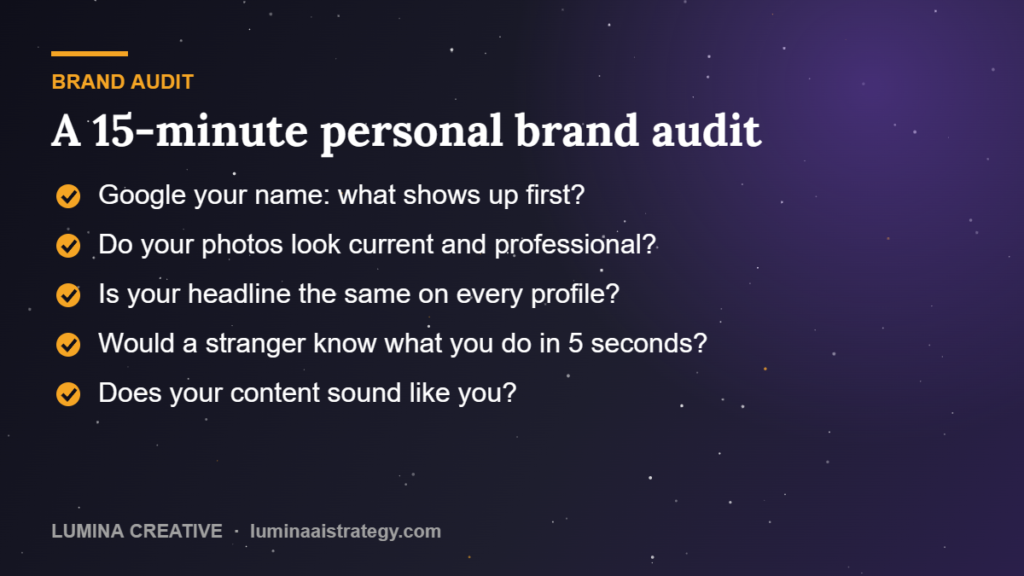
Before you build anything new, see what people already find. Search your name and your business name in Google. Look at your LinkedIn profile, website and social accounts side by side. Ask yourself whether a stranger would understand what you do within five seconds, whether your photos look current, and whether your headline and description say the same thing everywhere. Note every gap. Those notes become your first task list.
Visual consistency without a big budget
You do not need an expensive design package to look professional. You need consistency.
- One current, high-quality headshot used on every platform.
- Two or three brand colors and one or two fonts, used the same way everywhere.
- A simple banner image for LinkedIn and your other profiles that repeats your positioning sentence.
- Templates for social posts and documents so everything you share looks related.
Consistency builds recognition, and recognition builds trust.
Show up consistently
Personal branding for entrepreneurs is built through repetition. Choose one main platform where your ideal clients spend time, and commit to a rhythm you can keep, such as two posts a week. Share what you know, what you are learning and the results you help clients achieve. Comment thoughtfully on other people’s posts. Over months, this steady presence does more than any single viral moment.
Build your personal brand in 90 days
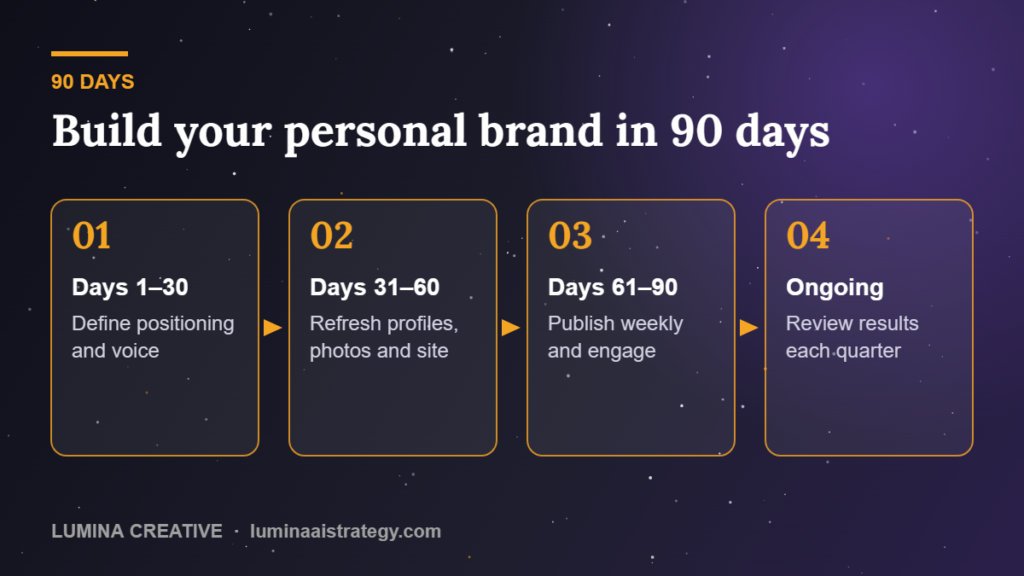
- Days 1–30: Write your positioning sentence, define your voice and complete the audit.
- Days 31–60: Update your headshot, profiles, website About page and banners so they match.
- Days 61–90: Publish on a weekly schedule and engage with your audience every week.
- Every quarter: Review what resonated, what brought inquiries and what to adjust.
Protect your personal brand
Your brand is also shaped by what you choose not to do. Respond to every inquiry promptly and professionally. Keep promises on deadlines. Handle complaints privately and calmly. Avoid posting in anger. Clients notice how you behave when things go wrong as much as when things go right, and that behavior becomes part of your reputation.
Personal branding mistakes entrepreneurs make
- Copying someone else’s style. What works for a famous creator may not fit your clients or your personality. Borrow structure, not identity.
- Being everywhere at once. Spreading thin across five platforms usually produces weak results on all of them. Start with one.
- Talking only about yourself. The strongest personal brands focus on the client’s problems and progress.
- Hiding your expertise. Many experienced entrepreneurs undersell what they know. Share real examples, lessons and results.
- Letting profiles go stale. An outdated photo or old job title quietly signals that you are not paying attention.
- Inconsistent messages. If your website says one thing and your LinkedIn says another, people are unsure what you actually do.
How your personal brand supports your business
For most small businesses, the owner’s reputation is a major reason clients choose to buy. A strong personal brand makes every other part of marketing easier: referrals arrive warmer, proposals close faster and prices are questioned less. Clients feel they already know you before the first call.
Your personal brand and business brand should work together. The business brand carries the name, offers and visual identity. Your personal brand carries the trust, the story and the expertise behind it. Link them clearly: mention the business in your profiles and feature yourself on the business website’s About page.
Measure what your personal brand is doing
Track a few simple signals each month: profile views, new connections or followers in your target audience, comments from potential clients and, most importantly, inquiries that mention your content or profile. When someone says “I have been following your posts,” your personal branding is working.
Tell your story with purpose
Stories make a brand memorable. Share the moment you decided to start your business, a lesson from an early mistake or a client result you are proud of. Keep each story short and connect it to a takeaway your audience can use. Personal branding for entrepreneurs is strongest when your story helps the reader, not just introduces you.
Use proof to build credibility
Testimonials, case studies and before-and-after examples show that your promise is real. Ask satisfied clients for a short quote about the result they achieved, and feature it on your website and profiles. Credentials, years of experience and media mentions also help, as long as you present them in service of the client’s confidence rather than as a list of accomplishments.
Research from the Edelman Trust Barometer has consistently found that trust strongly influences buying decisions. For entrepreneurs, a clear and consistent personal brand is one of the most practical ways to earn that trust before the first conversation.
Start this week
Write your positioning sentence today. Then update one profile so it matches. Small, consistent steps are how lasting personal brands are built.
Choose the right platform for your personal brand
Pick the platform where your best clients already spend time. For most service-based entrepreneurs who sell to other businesses, that is LinkedIn. For consumer-facing businesses, Instagram or Facebook may fit better. If clients search for your expertise, a blog or YouTube channel builds lasting visibility.
Whatever you choose, your website should be the home base. Social platforms change their rules, but your website and email list belong to you. Link every profile back to your site, and invite interested readers to join your email list, so your personal brand keeps working even if a platform changes.
Personal branding for entrepreneurs over 50
Experienced entrepreneurs often have the strongest raw material for a personal brand: decades of judgment, relationships and results. The challenge is usually presentation, not substance. Update your photos, simplify your profiles, and translate your experience into the outcomes clients care about today. Your history is an asset when you connect it clearly to the problems you solve now.
Key takeaways
- Your brand reflects your standards, not just your visuals.
- Clarity and consistency build trust before the first call.
- Self-respect in business shows up as confidence online.
Ready to align your brand, website and message? Explore LuminaGrowth™ or book a Clarity Call.