

Keywords vs Topic Clusters: How Topical Authority Drives Organic Traffic
For years, SEO advice boiled down to one idea: pick a keyword and repeat it. That approach no longer works. Search engines and AI assistants now evaluate whether your site truly understands a subject, not whether a phrase appears enough times. Topic clusters SEO is the practice of grouping related content so search engines see your business as an authority.
The strategy that replaced keyword stuffing is topic clusters SEO, and it is one of the most practical ways a small business can build lasting visibility.
Keywords vs topic clusters at a glance
- Keyword approach: one page targets one phrase, often thin and repetitive.
- Topic cluster approach: one in-depth pillar page covers a broad subject, supported by focused articles that each answer a specific question and link back to the pillar.
Why topical authority matters
When your site covers a subject thoroughly and organizes that coverage clearly, search engines can see that you are a reliable source. Each supporting article strengthens the pillar, and the pillar lends credibility to each supporting article. That interconnected depth is what topical authority means.

It also matches how people search today. Customers ask full questions, and AI-generated answers pull from sources that explain a subject clearly and completely.
How to build your first topic cluster
- Choose a core topic tied directly to a service you sell, such as website design for local businesses.
- List the questions customers ask about it: cost, timeline, what to prepare, how to choose a provider.
- Create or update a pillar page that covers the topic broadly and answers the big questions.
- Write supporting articles, one per specific question, each going deeper than the pillar can.
- Link everything together. Every supporting article links to the pillar, and the pillar links out to each article.
Common mistakes to avoid
- Writing several near-identical articles that compete with each other.
- Publishing articles with no links to or from related content.
- Choosing topics that have nothing to do with what you sell.
What a topic cluster looks like
A topic cluster has two parts. The pillar page covers a broad topic in depth, such as “Small business website design.” The supporting posts each answer one specific question within that topic, such as “How much does a small business website cost?” or “Signs you need a website redesign.” Every supporting post links to the pillar, and the pillar links out to each supporting post.
This structure helps readers move naturally from a general overview to the exact answer they need. It also helps search engines understand that your site covers the subject thoroughly. That is the heart of topic clusters SEO: organizing what you already know into a structure that makes your expertise easy to see.
Why topic clusters SEO beats chasing single keywords
Targeting one keyword per page made sense when search engines matched words more literally. Today, Google tries to understand topics and the intent behind a search. A site with ten connected pages about website design sends a much stronger signal than ten unrelated pages that each target a slightly different phrase.
Topic clusters also help in practical ways:
- Less overlap. Planning a cluster up front stops you from writing several posts that compete for the same search.
- Better internal links. Every new post has a clear place to link to and from.
- Easier content planning. Your blog calendar becomes a list of questions to answer, not a guessing game.
- Stronger topical authority. As the cluster grows, your whole site becomes more credible on that subject, including your service pages.
Google’s own guidance on helpful, people-first content rewards exactly this kind of depth and focus.
How to find subtopics for your topic cluster
The best subtopics come from real questions, not from guessing.
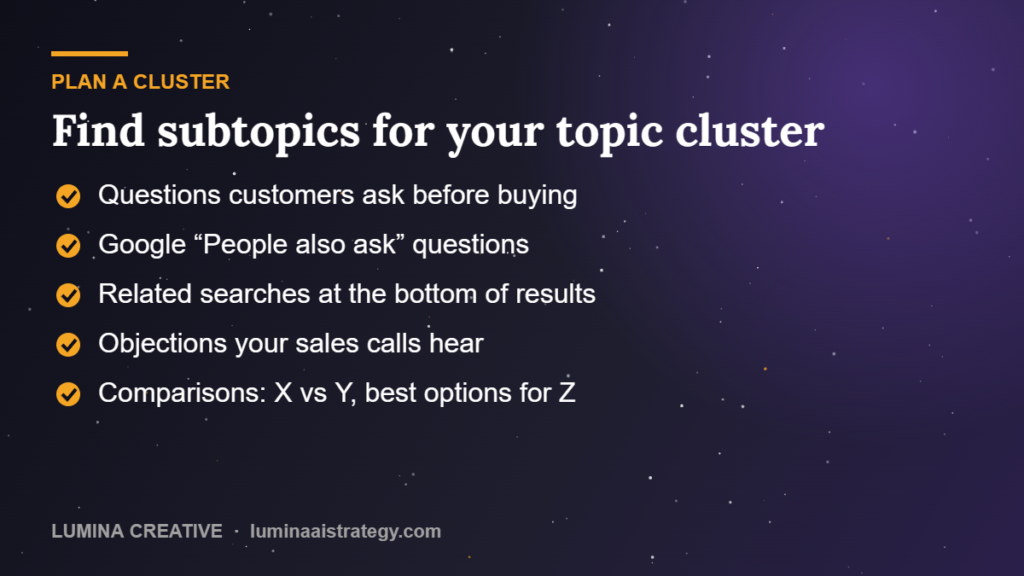
- Customer questions. List what people ask before they buy, by phone, email and in person.
- “People also ask.” Search your core topic and note the questions Google shows.
- Related searches. Scroll to the bottom of the results page for more ideas.
- Sales objections. Every hesitation you hear on a call can become a helpful post.
- Comparisons. Posts that compare options, such as “DIY vs agency,” answer high-intent searches.
Aim for eight to twelve subtopics for your first cluster. That is enough to show depth without becoming overwhelming.
Build your first topic cluster
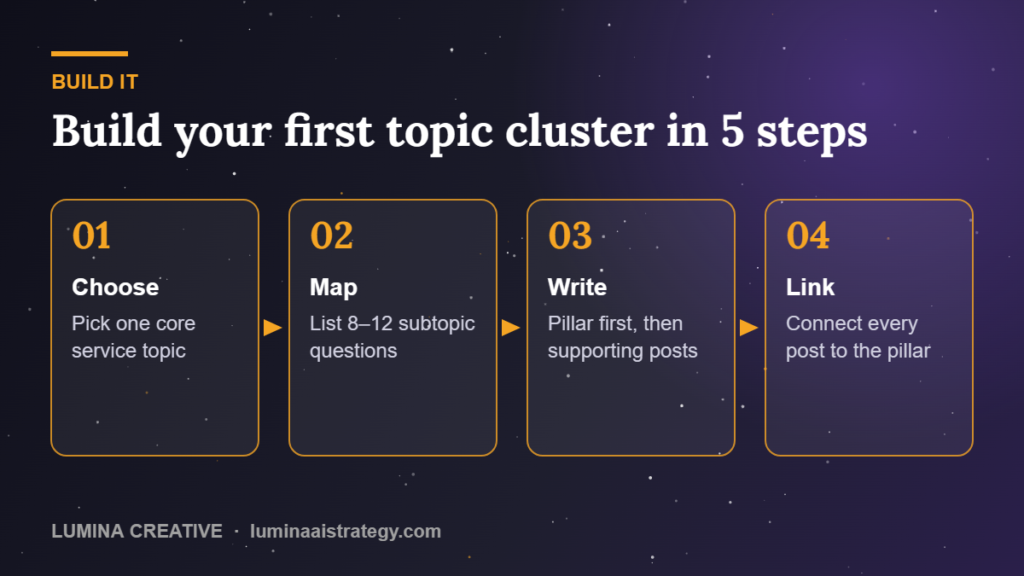
- Choose one core topic tied to a service that brings in revenue.
- Map eight to twelve subtopics using the research methods above.
- Write the pillar page first, covering each subtopic briefly and linking to the detailed posts as they are published.
- Publish supporting posts on a steady schedule, such as one per week.
- Link everything together: each post links to the pillar and to one or two related posts in the same cluster.
Then measure. In Google Search Console, watch how many searches the cluster appears for over three to six months. Topic clusters SEO is a long game, but the results tend to build on each other.
Topic cluster examples for small businesses
- A bookkeeper: pillar on “Small business bookkeeping,” with posts on monthly closing, choosing software, tracking receipts and preparing for tax season.
- A detailing company: pillar on “Car detailing services,” with posts on ceramic coating, interior cleaning, maintenance schedules and pricing.
- A consultant: pillar on “Business process improvement,” with posts on mapping workflows, choosing tools, writing SOPs and measuring results.
Each example connects directly to a paid service. That is the goal: content that builds authority and leads naturally to your offer.
How to write a strong pillar page
Your pillar page is the hub of the topic cluster, so it deserves extra care. A good pillar page gives a clear, complete overview of the topic without trying to answer every detailed question in full.
- Open with a plain definition and who the page is for.
- Use one section per subtopic, with two or three paragraphs and a link to the detailed post.
- Add a table of contents so readers can jump to the part they need.
- Include a clear next step, such as a consultation, quote or download, tied to the service the cluster supports.
- Update it as the cluster grows. Each new supporting post should be added and linked from the pillar.
Most pillar pages land between 1,500 and 3,000 words. Length is not the goal; completeness is.
Internal linking rules for topic clusters
Internal links are what turn a group of posts into a real cluster. Keep these rules simple and consistent:
- Every supporting post links to the pillar page, ideally in the first few paragraphs.
- The pillar page links to every supporting post.
- Each supporting post links to one or two closely related posts in the same cluster.
- Use descriptive link text that tells readers what they will find, not “click here.”
- Check links each quarter and fix anything broken or outdated.
These links help readers find more useful answers, and they help search engines understand how your content fits together.
Common topic cluster mistakes
- Clusters that are too broad. “Marketing” is too big for a small business cluster. “Local SEO for contractors” is a better fit.
- Writing posts without linking them. A topic cluster without internal links is just a list of articles.
- Thin supporting posts. Each post should fully answer its question. A short post that leaves readers searching again weakens the whole cluster.
- Never updating the pillar. As you publish new posts, the pillar must grow with them.
- Choosing topics nobody searches for. Base subtopics on real customer questions and search data, not on what is easiest to write.
How long until topic clusters SEO works?
Expect early signs within two to three months, such as more searches showing your pages in Search Console, and stronger results over six to twelve months as the cluster grows. Consistency matters more than speed. One well-linked post per week will usually outperform a burst of rushed posts followed by silence.
Your topic clusters SEO starter checklist
- Choose one core topic linked to a paying service.
- List eight to twelve real customer questions as subtopics.
- Write and publish the pillar page.
- Publish one supporting post each week, each linking to the pillar.
- Add links from the pillar to every new post.
- Review Search Console results every month and refresh weak posts.
Follow this checklist for one topic before you start a second cluster. A single complete cluster builds more topical authority than three half-finished ones, and it gives you a repeatable process for every service your business offers.
A final word
Topic clusters SEO rewards patience and organization more than volume. Start with what your customers already ask you, answer it well, connect the answers, and keep going. Over time, your site becomes the obvious resource on the topics that matter most to your business.
Key takeaways
- Depth and structure now beat repetition.
- One pillar page plus focused supporting articles forms a cluster.
- Internal links are what turn separate posts into authority.
Want help mapping clusters around your services? Explore LuminaRank™ or book a Clarity Call.